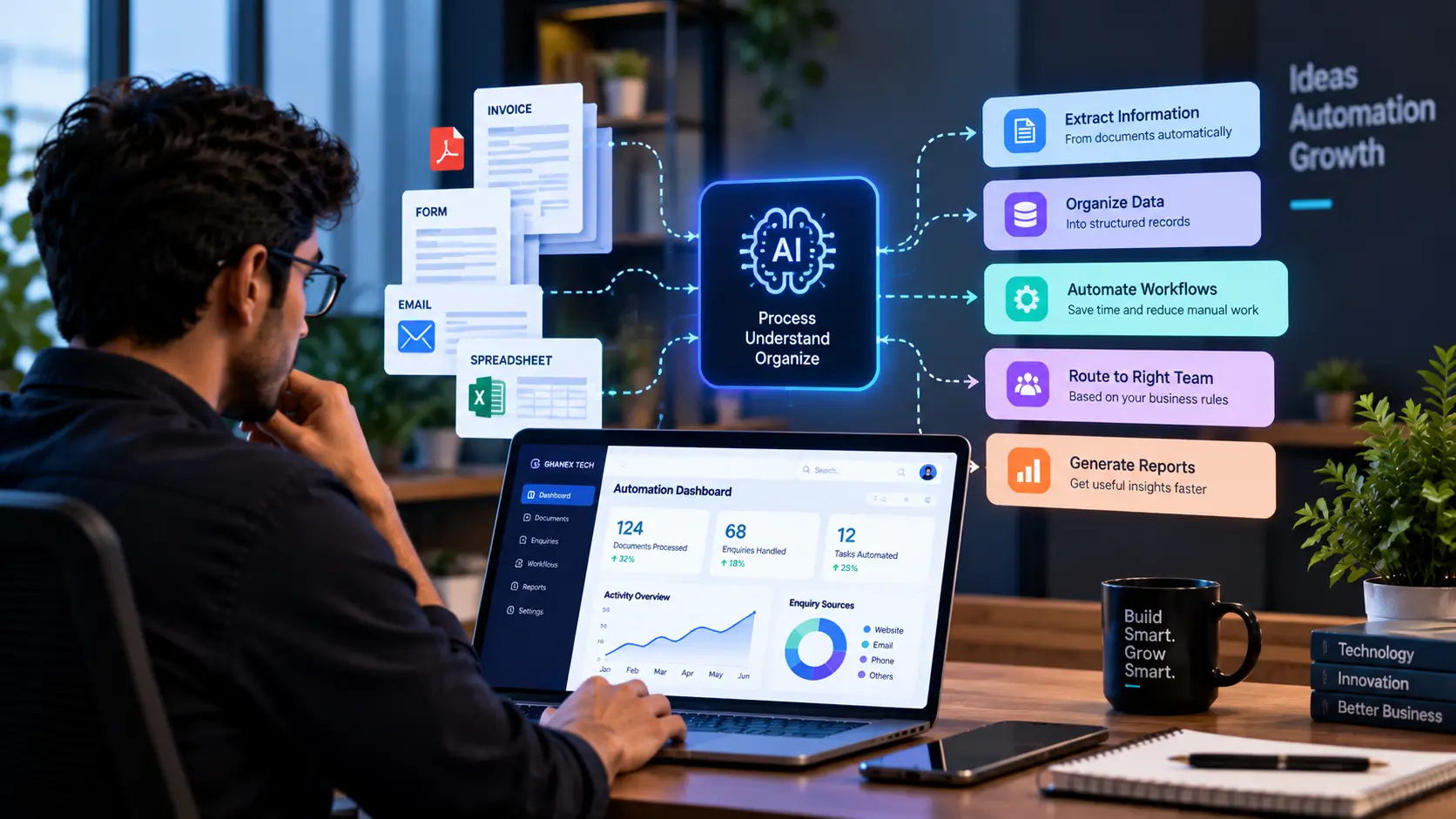
The Everyday Work That Takes More Time Than It Should
Think about the small tasks that happen in a business every single day. Someone enters information into a spreadsheet. Another person checks documents and copies details into a system. Customer enquiries need responses, reports need to be prepared and information needs to be organized. Individually, these tasks may seem simple. But when they happen repeatedly, they can take up a surprising amount of time. This is where automation can make a difference. Instead of asking people to repeat the same steps manually, businesses can use software to handle certain routine activities. And with the help of artificial intelligence, some of these processes can become more flexible and intelligent. The goal isn't to replace every manual process. It's to make everyday work easier where technology can genuinely help.
First, What Is Automation?
Automation means using technology to perform tasks that would otherwise require repeated manual effort. For example, imagine a business receives enquiries through a website. Without automation, someone may need to open each enquiry, copy the details into a spreadsheet and notify the relevant team member. With a simple automated workflow, the system could: Receive the enquiry. Validate the submitted information. Store the details in a database. Notify the responsible team member. Send an acknowledgement to the customer. The process still needs proper planning, but fewer steps require manual attention. Automation is particularly useful when a task follows a predictable set of rules.
Where Does Artificial Intelligence Come In?
Traditional automation generally follows instructions and predefined rules. Artificial intelligence can help when a task involves understanding information, identifying patterns or working with less structured data. Consider a business receiving hundreds of documents in different formats. A traditional system might require someone to manually enter information from each document. An AI-assisted system could use technologies such as Optical Character Recognition (OCR) and intelligent data extraction to identify useful information and organize it into structured records. Some practical applications include: Extracting information from invoices and documents. Classifying incoming emails and support requests. Summarizing lengthy documents. Helping users find information through natural-language questions. Identifying patterns in business data. Supporting customer service with AI assistants. AI does not guarantee that every result will be correct. Important information should still be reviewed, especially when accuracy matters.
Five Practical Ways Businesses Can Use AI and Automation
You don't need to build a complicated AI platform to start using these technologies. Sometimes, solving one repetitive business problem is a much better starting point. 01. Document Processing Businesses regularly work with invoices, forms, applications and other documents. OCR and intelligent extraction can help convert information from these documents into structured digital records, reducing repetitive data entry. 02. Customer Enquiry Management Incoming enquiries can be organized, categorized and directed to the appropriate team. AI assistants can also help answer common questions, while important or complex requests can be passed to a human team member. 03. Everyday Workflow Automation Routine activities such as assigning tasks, sending notifications and updating records can often be automated using predefined rules. This helps teams spend less time coordinating repetitive activities. 04. Report Preparation and Data Organization Businesses often collect information from different sources. Automation and AI-assisted tools can help organize that information, summarize relevant details and prepare reports for review. 05. Internal Knowledge Assistance Employees sometimes spend time searching through documents, policies and internal information. A properly designed AI-powered knowledge assistant can help users find relevant information more conveniently, provided the underlying data is accurate and access permissions are respected.
AI Is Not Always the Answer
It's easy to assume that every business problem needs an AI solution. In reality, that's not always true. Some processes only need a simple automated workflow. Others may need better software, clearer data organization or a change in how information is managed. Before choosing a technology, ask: Is this task repeated frequently? Does it follow a predictable process? How much time does it currently take? Is the required information available digitally? What happens if the system makes a mistake? Does the process involve sensitive information? Would simple automation solve the problem? The right solution is the one that addresses the actual challenge, not necessarily the one with the most advanced technology.
What Should Businesses Consider Before Getting Started?
AI and automation can be useful, but successful implementation requires more than connecting a tool and expecting everything to work. A few things deserve attention. Understand the Process Identify the problem before deciding what to automate. A poorly organized process can become even more difficult when automated. Check Data Quality AI systems depend on the information they receive. Incomplete, outdated or incorrect data can affect the quality of their output. Protect Business Information Consider where information is stored, who can access it and how third-party services handle submitted data. Keep Human Review Where It Matters Important decisions should not automatically depend on AI-generated results. Build appropriate review and approval steps into the workflow. Start Small Choose one task, test the solution and evaluate whether it actually improves the process before expanding it.
A Simple Example: From Manual Documents to an Automated Workflow
Imagine an organization that receives application forms every day. The existing process involves opening each document, reading the information, entering details into a spreadsheet and organizing the records. A possible automated workflow could look like this: A user uploads a document. The system extracts text using OCR. An AI-assisted process identifies relevant fields. The extracted information is converted into structured data. A team member reviews the information. Approved records are saved into the database. The information becomes available for searching and reporting. This kind of workflow can be useful in situations where teams process large numbers of similar documents. The important part is to design the process around actual requirements, including validation, error handling and human approval.
The Future Is About Using Technology Thoughtfully
AI and automation are opening up new possibilities for businesses of different sizes. But meaningful digital transformation doesn't happen simply by adopting every new tool. It starts with understanding where time is being spent, identifying processes that could work better and choosing technology that addresses those needs. For some businesses, that might mean automating document processing. For others, it could involve building a custom application, connecting existing systems or introducing an AI-powered assistant. The best place to start is often one problem that your team deals with every day.
Final Thoughts
AI and automation aren't just topics for large technology companies. They can also help everyday businesses rethink how routine work gets done. Start with a clear problem, choose a practical solution and improve it based on real experience. At GHANEX TECH, we believe technology should have a purpose. It should make things easier, help people work smarter and create room for better ideas.
Build Smart. Grow Smart.